Friday, December 2, 2011

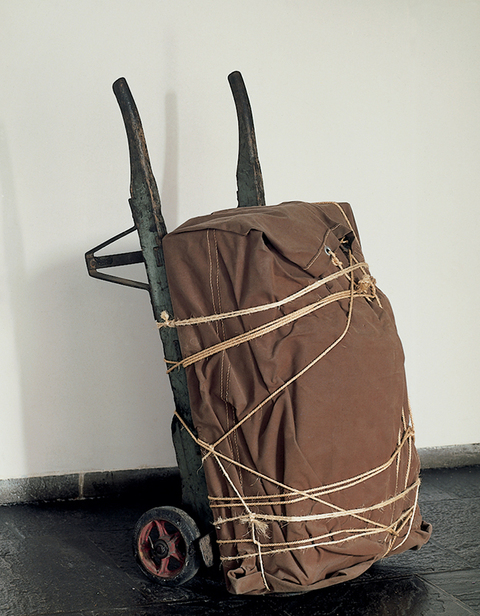
Emily: Christo's Wrapped Package on a Hand Truck


Christo, the arist of this sculpture peice, was born in 1945. Christo grew up in the Soviet Block, and spent years surrounded by a culture which actively promoted half-truths and outright lies to its citizens, as a way of staying in power. When 'everybody knows what a thing looks like', that usually means that people have stopped noticing it. He studied art, and in 1958 started to become famous for his 'Packages and wrapped Objects'. This peice is called 'A Package on a Hand Truck'. Christo's way of wrapping things realtes to The Road because of the constant need for The Man and The Boy to see things in a different way. They were stuck in an apocalypse, and they still 'carry the fire'

Thursday, December 1, 2011

Eddy's incredibly faint image


This is a barley visible smudge of graphite on a canvas. It was "drawn" by Shirazeh Houshiary an english "artist" originally from Iran. Shirazeh claims the idea for this painting was inspired when she saw her breath evaporate on a mirror and realized this was a representation of human life. As Shiazeh says " I realized this is who we really are—not concrete and not permanent, or definable. It is this illusive presence, which can only be experienced directly, a part of life, or breath.". I found this very similar to Cormac McCarthy's rather bleak out look on life in the road. Everything is fleeting and there is a constant knowing through out the book that the boy and the man will eventually fade, just like breath on a mirror.

Rie's George Grosz painting


This painting was done by George Grosz. He was a German artist known especially for his savagely caricatural drawings. In November 1914 Grosz volunteered for military service praising "War to end wars". But he was given a discharge after hospitalization in 1915 and disillusioned by the reality of the war. In 1916 he changed the spelling of his name to George Grosz as a protest against German nationalism. And He joined the Berlin Dada(The movement primarily involved visual arts, literature. It concentrated its anti-war politics ) in 1917. He juxtaposed objects create a surreal experience. It represents a similar descent into hell as did the peace following World War I. He wanted to show how there's no peace in reality in terms of fighting in a war.

When I first saw this paining, I immediately thought the guy in the middle was just like the man in The Road. Both of them disillusion by the environment that surrounding them and have no hope for their life. Just walking straight. Also the darkness and the junks in the painting are caused by a national disaster like in the novel. 

Valerie's image


This is a painting by the artist Mark Bradford called Bread and Circuses. The painting is Mixed-media collage on canvas by 133 x 253 in. Bradford creates “collages” – works made of paper but with the visual impact of painting. The picture has many colors, is a small circle bright silver piece layered with drawings, string and paper. The connection between The Road and the art is that in life you have many ways you can take but you have to be careful and responsible taking the risks that might happen. In life they are good and bad guys but you have to protect yourself, being responsible, do your best and keep moving forward. 

Molly's minimalist sculpture


This piece is from a collection by sculptor David Smith (1906-1965) entitled 'Cubes and Anarchy' (The collection is quite aptly named, I thought, to be compared to The Road). He was an American Abstract Expressionist sculptor and painter best known for creating large steel abstract geometric sculptures. Perhaps his most revolutionary concept was that the only difference between painting and sculpture was the addition of a third dimension; he declared that the sculptor's "conception is as free as a that of the painter. His wealth of response is as great as his draftsmanship." His sculpting works were an expression of the energy he had after working as a welder during the Second World War. I find the precarious position of the cubes speaks volumes to many causes, not just The Road. In respects to the novel, the cubes represent the people still surviving on the barren Earth. Perhaps they don't want to be, but they are reliant on each other to stay alive; no cube could 'stand' without the cube below it. The precarious positioning and angel of the tower, I find, represents the fragile social structure exhibited in the novel. The thin disk at the base of the sculpture seems to be the anchoring element and the slight movement of it could possibly send the whole tower tumbling down, just as any wrong move from the man or the boy in The Road could send their small place in the world into ruins. 
Michael's ironic image


The artist who created this picture above is Maurizio Carrelan. He is known for his dark humor and is a comical artist who once made a sculpture of the pope hit with a meteor. This picture could be referring to chaos and fire being caused by humans and that we as a population are to blame. The art is closely related to the book because the apocalypse could have been caused by humans and that we could be responsible for our own demise. 

Rachel's Georgia O'Keefe drawing

Georgia O’Keeffe started taking classes at the University of Virginia for art teachers when she lost the confidence in achieving distinction in her art work. The art instructor, Arthur Wesley Dow, expressed to the class his belief on art: the goal of art was for the artist to express their personal ideas and feelings, such that the subject matter could be realized through the harmonious arrangements of line, color, and shading. O’Keefe took his belief to thought and tried to put his theory to a test. She began creating art to express her own emotions instead of imitating realism. In my opinion, O’Keefe created this charcoal drawing called No.8 to express the feeling of her being trapped. 

In the center of piece No.8 , there appears to be two people, one smaller than the other, being engulfed by the bleak vortex that surrounds them. This Drawing, in reference to The Road by Cormac McCarthy, depicts the man and his son being overcame by the dreary and bleak world around them.